DOOM Eternal Review
id Software pushes its 2016 reboot to the limit. DOOM Eternal is the most demanding — and exhilarating — shooter on the market.
The 2016 reboot reminded everyone what DOOM was. DOOM Eternal turns that formula into something closer to a violent rhythm game — a combat puzzle you solve at 100 miles an hour.
Developed by id Software and published by Bethesda Softworks, it launched in March 2020 on PC, PlayStation 4 and Xbox One. The Doom Slayer is back to end Hell's consumption of Earth, and this time id also wants you to care about the mythology behind him. Whether you do is another matter — the shooting is the star.
The combat loop is the game
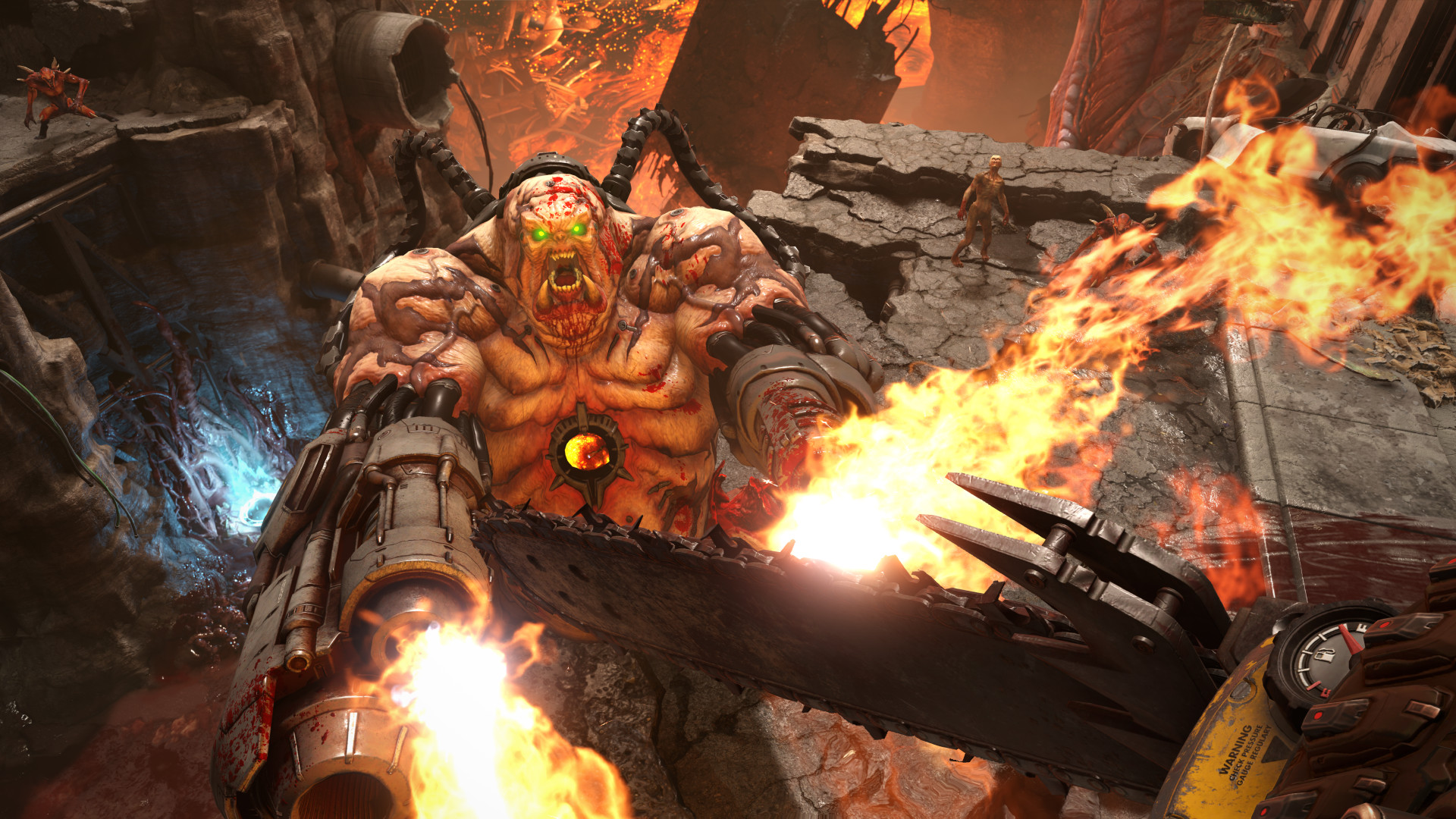
Eternal forces you to keep moving and keep switching tools. Chainsaw demons for ammo, flame them for armour, glory-kill for health. Stand still and you die; master the loop and you become a tornado of weapon-swaps and dashes. It is the most mechanically demanding mainstream shooter in years, and once it clicks it's pure flow.
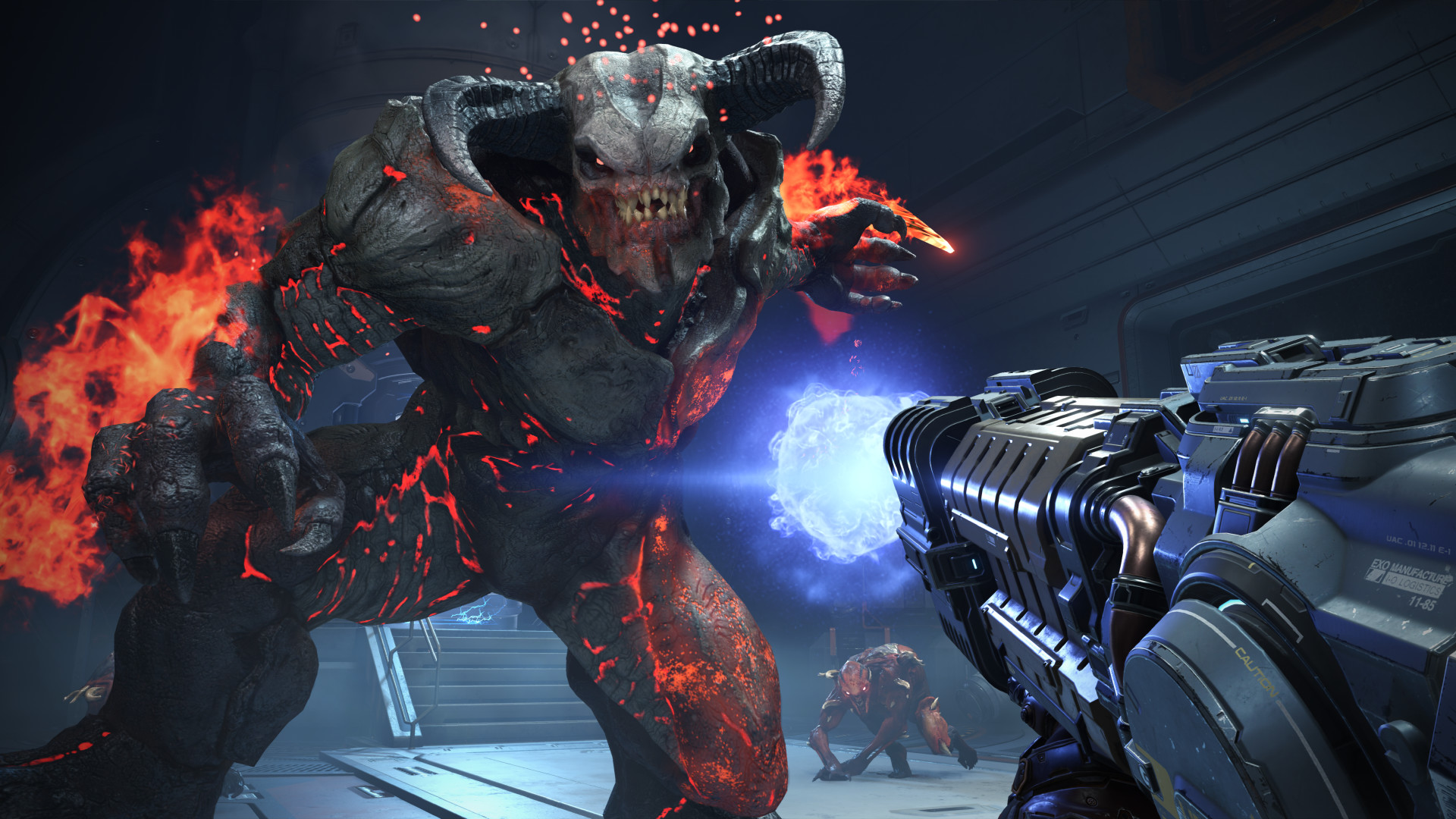
The depth comes from how the arsenal and the enemy roster interlock. id's own description is a "fantasy combat puzzle", and enemy weak points are the clearest expression of it: pick the right tool and a dangerous demon is suddenly manageable. The Super Shotgun's grappling hook yanks you straight into a target, secondary fire modes change each weapon's job, and upgrade points and mastery challenges keep nudging you to experiment. At its best you are reading a battlefield in real time, deciding which threat to strip first. At its worst, the tutorials are prescriptive about the "right" answer, and juggling several progression systems can feel like homework.
Arenas, traversal and the platforming question
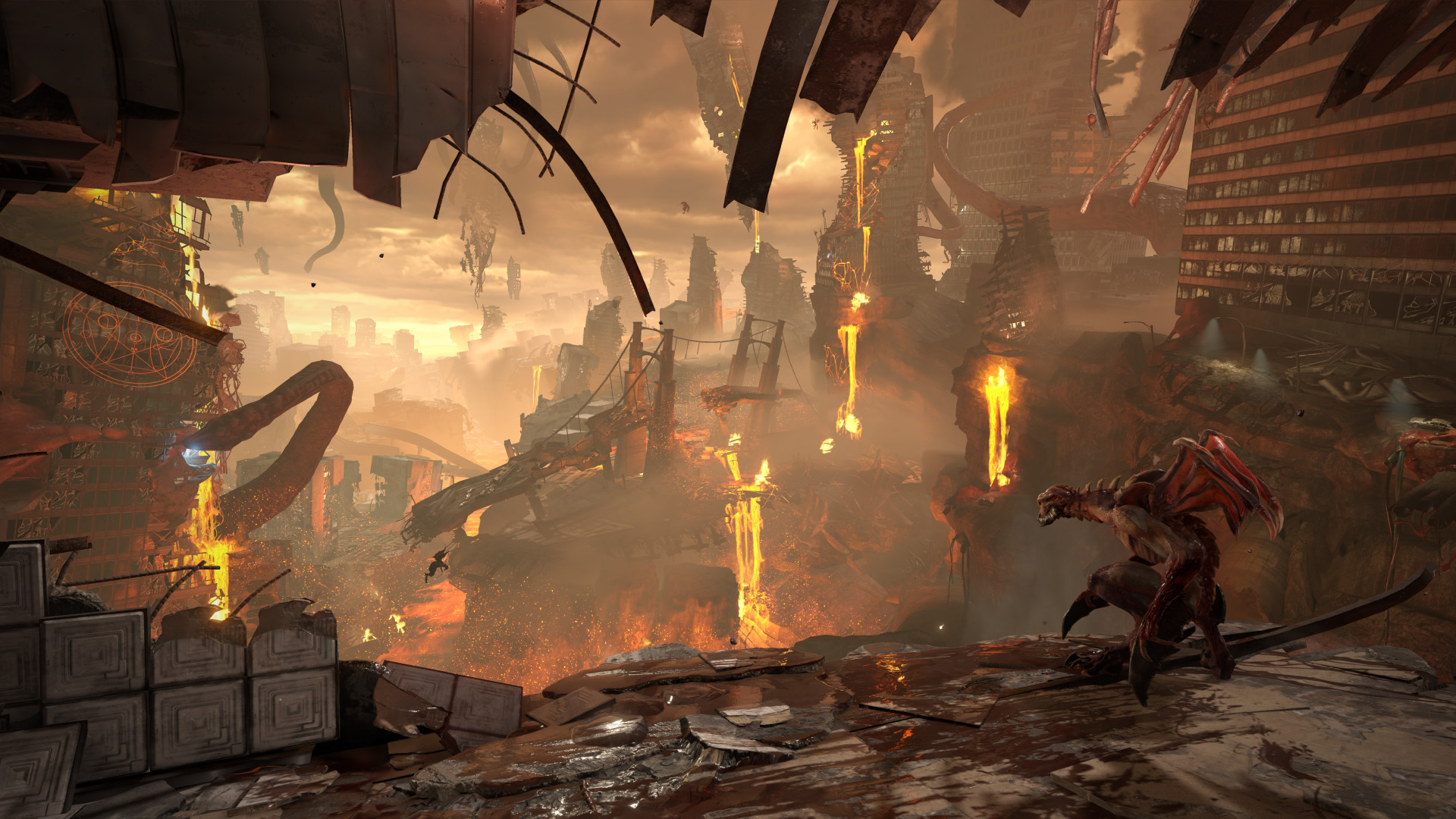
Levels are more open, diverse and vertical than 2016's, and the dash and grapple turn arenas into playgrounds you can use to retreat, reposition and strike again. Hell-scarred cities and stranger, otherworldly locations give it far more visual variety than its predecessor. Between fights, though, id added dedicated platforming segments to break up the pace, and they divide opinion. Some are a welcome breather; others are fiddly jump puzzles that stall the momentum a game this fast depends on.
It is also more approachable than its reputation suggests. Five difficulty levels run up to the permadeath Ultra-Nightmare, and if you die repeatedly in the same encounter the game offers Sentinel Armor to sharply reduce incoming damage — a smart, optional safety net that keeps less practised players moving.
Story and lore
The story is forgettable, and worse, it keeps interrupting. Where 2016 was knowingly thin, Eternal leans into world-building — the alien Maykrs and their plans for humanity, a cosmology explained through cutscenes and codex entries. It is overly serious and too long, and a lot of it lives in text you will skip. The good news is that you can ignore almost all of it and lose nothing that matters; the varied places it sends you are the real payoff. Battlemode, which pits a player-controlled Slayer against player-controlled demons, is a fun curiosity, but the campaign is why you are here.
Built to run
As you'd expect from id, the tech is immaculate — it holds a rock-solid frame rate on almost anything, which matters enormously in a game this fast. The heavy-metal score hammers every encounter home.
That score is Mick Gordon's, and it is the perfect engine for the combat. The game has travelled remarkably well, too: Panic Button's Nintendo Switch port arrived on December 8, 2020 with optional gyro aiming, and the PlayStation 5 and Xbox Series X|S versions followed on June 29, 2021, adding higher frame rates and ray tracing. On PC it scales down gracefully to modest hardware without losing its edge.
What's changed since launch
Eternal has had one of the more generous post-launch runs in the genre. The two-part campaign expansion The Ancient Gods — Part One on October 20, 2020 and Part Two on March 18, 2021 — concludes the Doom Slayer's saga and can be played standalone. Free updates added empowered demons that invade other players' campaigns, a Render mode that changes the game's visual style, and Update 6.66, which brought Horde Mode, BATTLEMODE 2.0, a playable Dread Knight demon and three new Master Levels. In August 2025 id made mods officially supported on PC with the PC Mods Update: a new launcher, more than 650 community mods to browse, and the idStudio beta for creators on Steam.
Welcome home, great Slayer. DOOM Eternal is available now!
— DOOM (@DOOM) March 27, 2020
Official resources
- DOOM Eternal on the Bethesda Slayers Club
- DOOM Eternal PC Mods Update (Bethesda)
- DOOM Eternal on Steam
- DOOM Eternal on PlayStation
- DOOM Eternal on Nintendo Switch
- DOOM Eternal on Wikipedia
The verdict
If you like being asked to learn a game, and rewarded handsomely when you do, this is essential. If you want a laid-back blast to unwind with after work, drop the difficulty or look elsewhere — Eternal is at its best when it is pushing you. It is rated M by the ESRB and PEGI 18, and the gore is exactly as enthusiastic as the name implies.
The resource management can feel like admin and the story is forgettable, but no shooter delivers a higher skill ceiling or a better sense of speed. If you like games that demand mastery, it pairs well with our Sekiro review.
What we loved
- Combat loop is a flawless high-speed puzzle
- Buttery performance even on modest rigs
- Killer heavy-metal soundtrack
- Movement and traversal feel incredible
What held it back
- Resource-juggling can feel like homework
- Story and cutscenes are throwaway
- Platforming sections divide opinion